Condition monitoring without the infrastructure
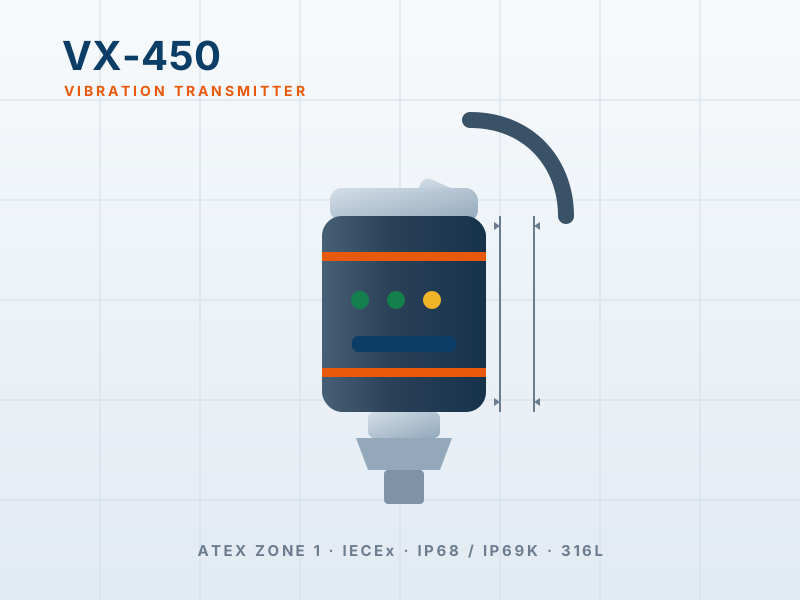
A conventional monitoring point needs an accelerometer, a shielded cable run, an intrinsically safe barrier, a junction box and a licensed electrician to open it. The VX-450 removes all four: it is the sensor, the barrier, the analyser and the data interface in one threaded body.
Because the FFT runs on the device, the RS-485 loop carries a decision instead of a waveform. A typical retrofit drops bus traffic by two orders of magnitude versus raw streaming, which means a single Modbus segment can carry 64 transmitters on ordinary twisted pair.
What you get on the wire
- 4–20 mA velocity RMS — scaled to ISO 10816 zones, wired straight into an existing PLC analogue card for trending and alarms.
- Modbus RTU registers — raw acceleration, velocity and envelope values, plus the 800-line spectrum on demand.
- Bearing envelope band — a factory-set high-frequency band for early-stage rolling element defect detection, independent of the overall RMS trend.
Built for where vibration actually happens
The 316L housing carries IP68 / IP69K, so washdown and driven-rain installations are fine. The element survives a 5 000 g half-sine shock, which matters on crushers and screens where a sensor that survives normal operation is not the same as a sensor that survives a tramp-metal event.
The M12 A-coded connector means cable replacement takes seconds and does not require re-certifying the hazardous-area installation.
Deployment
Standard lead time is 21 days, minimum order quantity 10 units. Each transmitter ships with a calibration certificate traceable to a DAkkS-accredited laboratory, the ATEX / IECEx certificate set, and a Modbus register map. Engineering support during commissioning is available to OEM and integrator partners at no additional cost.